
Who this was for
A B2B SaaS scale-up in the United Kingdom, seed-funded, with a two-person founding team and a domain pilot list of prospective customers. Company details withheld under NDA by mutual agreement.
The problem pattern
The founders were selling a product that did not yet exist and needed a credible first release within a funding runway — while avoiding the pattern where an MVP built too casually makes the first ten enterprise conversations impossible to close.
What made it hard
The first release had to be genuinely small in surface area but correct in the parts that are expensive to change: tenancy boundaries, permission model, billing entitlements and audit behaviour — on a timeline where a wrong architectural call would cost months, not weeks.
How the work was sequenced
- Ran a two-week discovery that converted the founders' vision into three signed-off journeys and one explicit non-goal list, plus written tenancy and billing decisions.
- Built the core domain with tenant isolation enforced at the data-access layer, not by convention, and permission roles modelled as data that could evolve.
- Purchased the generic parts — authentication, email delivery and billing portals — so engineering effort went to the workflow that differentiates the product.
- Shipped behind a feature flag to ten design-partner accounts, instrumented activation and completion of the core journey, and cut two features from release one when the data showed they served no tested hypothesis.
The solution in operation
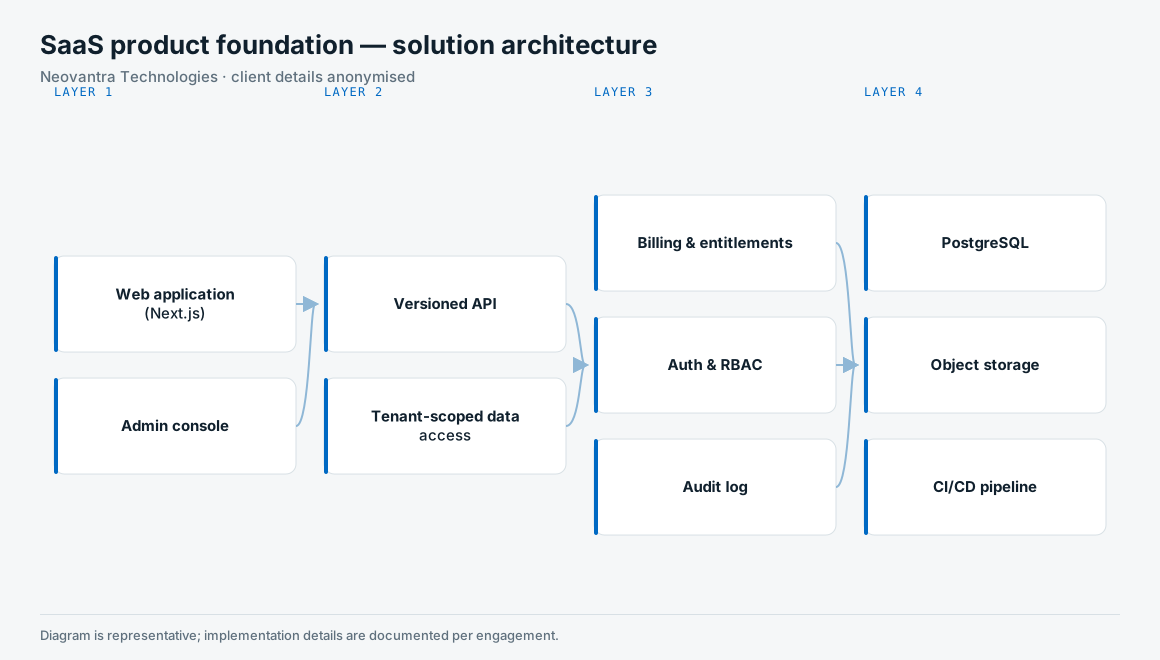
A Next.js application on managed infrastructure with a versioned API and automated pipeline: role-based access control, tenant-scoped data access, subscription billing with server-side entitlement checks, an administration console for support staff, an audit log for privileged actions, and a deployment process where every merge produces a release candidate.
Solution architecture
Timeline
16 weeks from kickoff to first paid release: two weeks discovery, nine weeks to an internally demoable core, five weeks of hardening, billing integration and staged customer onboarding; a dedicated team continues on the product roadmap.
Reported results
- First paid release shipped sixteen weeks after kickoff with tenant isolation and billing built in from the start rather than retrofitted.
- Deployment frequency moved from fortnightly manual releases to daily automated releases with rollback available on every deploy.
- Workspace onboarding completed in under ten minutes end to end, including billing setup and team invitation.
- Enterprise security questionnaires answered from a documentation pack assembled once, rather than assembled per deal.
What we took from it
- Deciding tenancy, permissions and billing before writing screens is what made the timeline achievable — retrofitting any of the three would have exceeded the runway.
- Buying the generic components removed maybe a fifth of the build and all of the maintenance burden nobody wanted to own.
- Cutting two features at week fourteen made the launch better, not later — the founders' own conviction changed when the data arrived.
Tools and technologies
Next.js · TypeScript · PostgreSQL · Stripe billing · GitHub Actions · AWS