
Who this was for
A multi-site outpatient care provider in the United States operating several specialty clinics under one group. Patient identifiers, clinic names and system vendors are withheld under NDA; the client's compliance officer co-owned the design reviews.
The problem pattern
Patients booked by phone because online booking wrote to no system of record, referral paperwork re-entered data into three applications, and anyone answering a call had no reliable view of the patient's appointments across sites — a journey problem created by integration debt rather than by clinical design.
What made it hard
Identity resolution across sites where a single patient could hold multiple records; consent and disclosure rules that differ by data element; a legacy practice-management system with a limited interface; and a clinical safety requirement that no workflow could silently present stale information as current.
How the work was sequenced
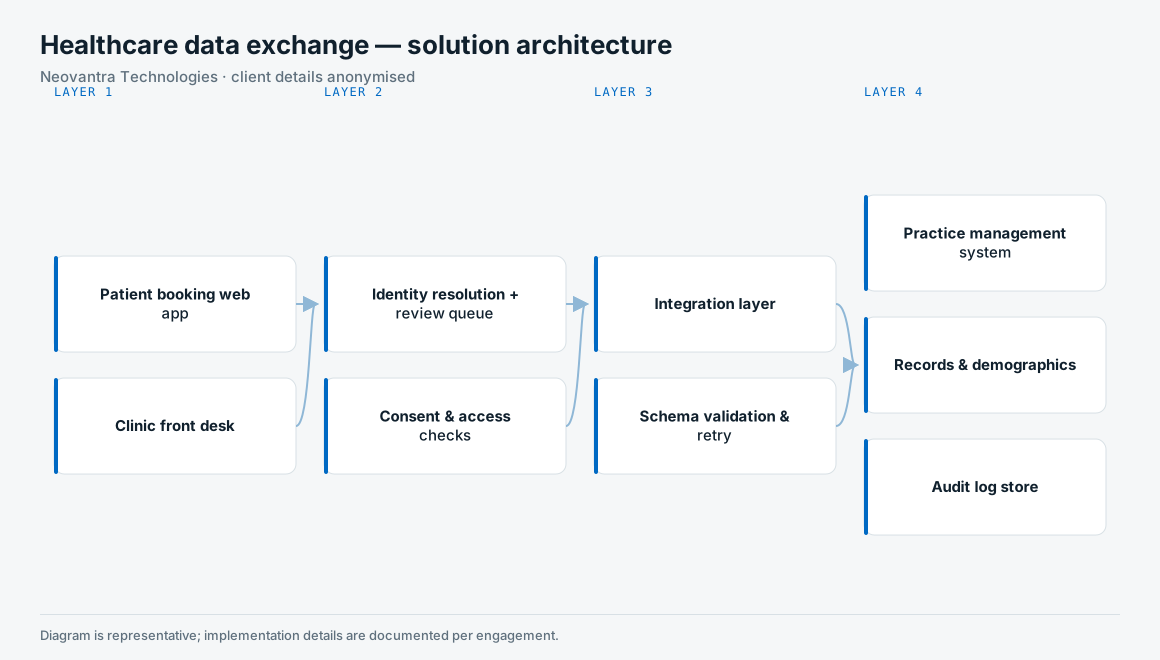
- Documented every source of truth and its ownership, then agreed a patient-identity matching rule with a human review queue for ambiguous matches rather than automatic merging.
- Built an integration layer behind the practice-management system using its documented API, with schema validation, retry with back-off and a monitored failure queue owned by the IT lead.
- Designed the booking journey save-and-resume, with availability computed from live slots and confirmations carrying the context a front-desk employee would otherwise read aloud.
- Ran a staged rollout at one clinic with paper-fallback for two weeks, measured booking completion and staff workarounds, then extended site by site.
The solution in operation
An integration service synchronises scheduling and demographic data across sites with a single reconciled patient view for staff, an online booking journey writing directly to the system of record, automated reminders and confirmations, and audit logging of record access with retention aligned to the provider's obligations.
Solution architecture
Timeline
30 weeks in three phases: six weeks of discovery and identity design, twelve weeks to booking and the staff view at two pilot sites, twelve weeks extending across the group with compliance review gates before each phase.
Reported results
- Online booking handled about seventy per cent of new-patient bookings within two months of launch, against effectively none before.
- Most referrals received before midday were processed the same day, with re-keying removed from the standard path.
- The pre-launch penetration test's high-severity findings were closed and retested before the first site went live.
- Cross-site appointment lookups that previously took several systems and notes now take one screen for authorised staff.
What we took from it
- Identity matching needs a human queue for ambiguous cases; getting this wrong in healthcare is a patient-safety event, not a data-quality ticket.
- Compliance review gates between phases slowed the calendar and shortened the argument — the second phase started with decisions already made.
- Staff workarounds during the pilot told us more about workflow fit than any survey would have.
Tools and technologies
TypeScript · FHIR-based exchange · API gateway · PostgreSQL · Azure