
Who this was for
A components manufacturer with two plants in northern India, producing for automotive and appliance customers, with an existing historian on one line and paper-based reporting on the rest. Client identity withheld under NDA; engagement sponsored by the head of operations.
The problem pattern
Shift reports were assembled by hand at the end of every shift and consolidated weekly, so downtime causes were discussed after the opportunity to act had passed. The same machine identifier appeared in different spellings across systems, making even historical analysis unreliable.
What made it hard
One plant ran modern PLCs with a historian; the other had legacy controllers, intermittent network coverage and no consistent asset naming. Data capture had to begin without interrupting production, tolerate disconnection for hours, and produce figures operations and finance would both trust.
How the work was sequenced
- Ran an asset-naming workshop that produced one canonical equipment hierarchy and a mapping table from every legacy identifier to it.
- Installed edge gateways that buffer locally and aggregate per line before transmission, deployed during planned shutdowns only.
- Modelled events around work orders, shifts and reason codes agreed with line supervisors — reason codes they would actually use at the terminal.
- Piloted on the highest-volume line for eight weeks, reconciling against manual counts, before rolling the playbook out line by line.
The solution in operation
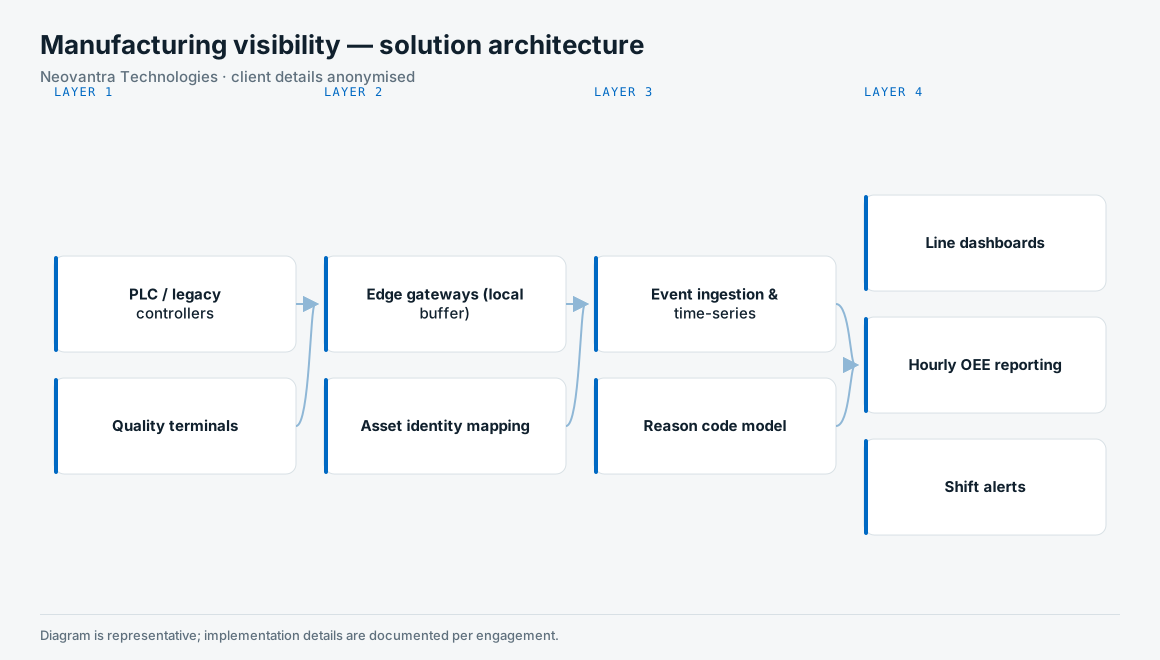
Edge gateways collect machine and quality events, buffer through connectivity loss, and stream to a platform that standardises asset identity, computes line performance hourly, records downtime with reason codes, and serves role-based dashboards for supervisors, plant heads and central operations — with alerts routed by rule to the people who can intervene during the shift.
Solution architecture
Timeline
14 weeks to a working pilot on one line, then a staged six-month rollout across both plants using a repeatable deployment playbook and per-line reconciliation sign-off.
Reported results
- Downtime events captured with cause codes for the first time, with line performance refreshed hourly instead of assembled manually each shift.
- Unplanned downtime events per month fell by about a fifth on the pilot line over the following quarter.
- Shift-reporting effort dropped from roughly ninety minutes per shift to about ten minutes of review.
- Rollout of an additional line took under two weeks using the pilot playbook, against a first line that took ten.
What we took from it
- The naming workshop was unglamorous and the most valuable week of the project — every later analysis depended on asset identity being settled first.
- Reason codes had to be co-designed with supervisors or they got entered as free text, destroying the reporting they were meant to feed.
- Buffering at the edge was tested by the plant's actual connectivity within the first fortnight, which would have lost a day of data without it.
Tools and technologies
Edge gateways · Python · Time-series storage · MQTT · Cloud analytics